history in place
What Heritage Days Teach Us About Looking at a Building Twice
Heritage Days in Paris: a practical guide to reading historic buildings, tracing their stories, and turning a city walk into a more meaningful experience.
What Heritage Days Teach Us About Looking at a Building Twice
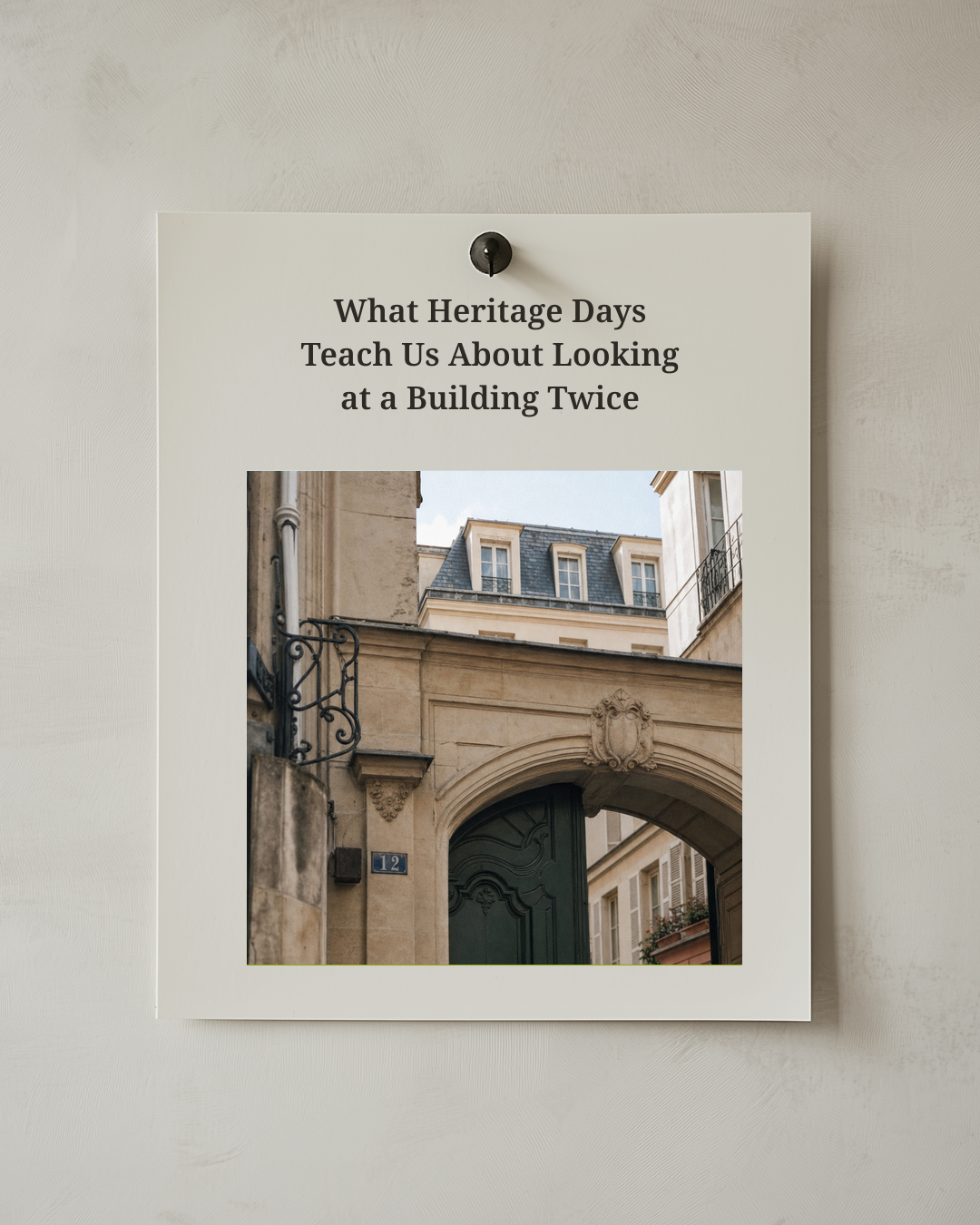
There are Paris mornings when a building you have passed a hundred times suddenly seems to be keeping a secret. Perhaps it is a green door with a lion’s head, a repaired bit of stone catching the pale September sun, or the small blue plaque you have never stopped long enough to read. The Journées européennes du patrimoine, on 19 and 20 September 2026, are a lovely excuse to give that second look its due.
Begin with the official national programme and the current Paris listing. They will tell you what is open, what requires a reservation, and what has changed. But leave room in the day for something less efficient and more rewarding: one building, one good question, and an unhurried walk home.
Choose a door to open—or a detail to follow
It is tempting to make Heritage Days into a very ambitious little race. There are doors that open only once a year, rooms usually kept behind a reception desk, archives, towers, workshops, chapels and restoration studios. All delightful. But a day feels richer when one place has time to become a story.
This year, choose the experience that matches your mood rather than the longest possible list. Let the rest of Paris remain a little mysterious.
For a grand civic moment: Hôtel de Ville
The City of Paris has listed the Hôtel de Ville in its 2026 Heritage Days programme. Its practical details are still being refined, so check the official Paris page before you go. Then give yourself ten minutes afterwards to walk along the Seine side of the building and notice how the façade changes when you are no longer simply hurrying past it.
For a restoration story: Grand Palais
The Grand Palais programme includes guided visits and a film about the monument’s restoration, alongside activities for different ages. It is a wonderful choice if you are interested in what buildings ask of the people who care for them: the scaffolding, the craft, the patient decisions that allow a grand room to remain grand. Check the live reservation status before you make a plan.
For a quieter clue: archives, archaeology and photographs
The Paris selection also points toward the Commission du Vieux Paris archives, archaeology reserves and photography-restoration visits. These are the gently thrilling choices for anyone who would rather see how a city keeps its memory than simply cross another famous threshold.
Make an afternoon of it
Here is my favourite kind of Heritage Days itinerary: begin at one official visit, take the long way to a nearby garden or café table, and carry a notebook small enough to be used. Photograph one whole façade and one detail. Write down the address exactly. Notice the threshold, the repair, the downpipe, the balcony railing or the way one building leans into its neighbour.
The point is not to make a perfect record. It is to leave the day with something more personal than a camera roll full of rooms you can no longer quite place.
An address is a small key
When you come home, try the exact street number and street name in a search. The Archives de Paris offers topographic research by street as well as urbanism collections, and its building-permit files are researched from the property address. You may find a clear trail; you may find only a promising thread. Either is part of the pleasure.
If a plaque catches your eye, the City’s commemorative-plaque dataset can be a useful next stop. And if you discover an older photograph, a reverse-image search may help you identify the institution, title or date behind it. Treat that first result as an invitation to investigate, not as the final word: the archive, museum or library record is where the story becomes dependable.
A few questions to tuck into your bag
- What is the first beautiful thing I notice—and what is the second, less obvious one?
- Where can I see evidence of care: a repair, a restoration, an altered window, a new use for an old room?
- Which person or ordinary habit might this building have witnessed?
- What would I want to remember about this address when September is gone?
A small prompt for the walk home
Write a page beginning: “The building looked ordinary until I noticed…” Add the address, the date, one material, one small imperfection and one question you cannot yet answer. A city is more generous when we allow a few questions to remain open.
Related reading
Continue the slower look with Medici Fountain Paris: History, Sculptures, and Hidden Beauty, an earlier This French Life story about returning to a familiar Paris landmark with more attention than haste.