paris slowly
Courtyards & Quiet: Slow Parisian Mornings
A gentle, half‑day walk through Paris courtyards—Jardins des Archives Nationales, Musée Carnavalet, and Hôtel de Sully to Place des Vosges—plus a simple at‑home ritual.
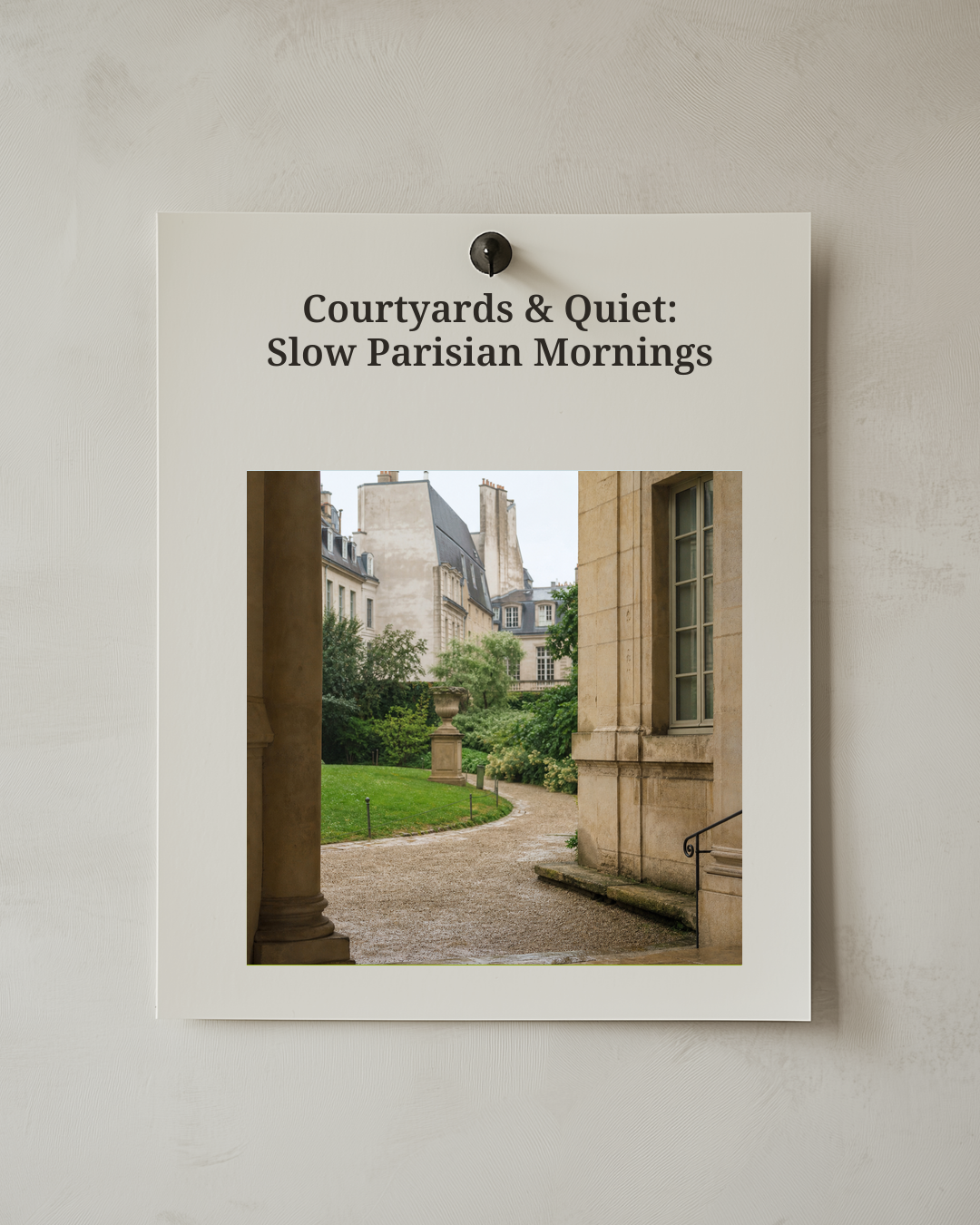
A morning is enough to feel how Paris slows at its thresholds. Step through a porte-cochère, across a gravel court, beneath an arcade, and the city’s tempo softens. This gentle circuit invites you to inhabit these in‑between places—courtyards, garden alleys, and passages—where domestic life and urban life meet.
A short history lens: inner greens, layered lives
In the Marais, a constellation of private mansions once hid their gardens from the street. Over time, those greens were gathered into today’s Jardins des Archives Nationales, a heritage site at the heart of the district. Originally designed by André Le Nôtre, the gardens were restored in 2008 and opened to the public in 2011. They bring together about 10,000 m² of plantings and some 300 species across several linked spaces, including the gardens of the Hôtels de Rohan, d’Assy, de Breteuil, de Fontenay, and de Jaucourt, as well as the narrow Ruelle de la Roche. Landscape designer Louis Benech added new compositions in 2011, and the garden of the Hôtel d’Assy still shelters a basin and artificial stream dating to 1848—alongside what is noted as Paris’s only Himalayan chestnut tree. These layers show how Paris’s interior landscapes were shaped by centuries of acquisition and care, creating pockets of cultivated privacy within the urban fabric.
Your slow-morning mini itinerary
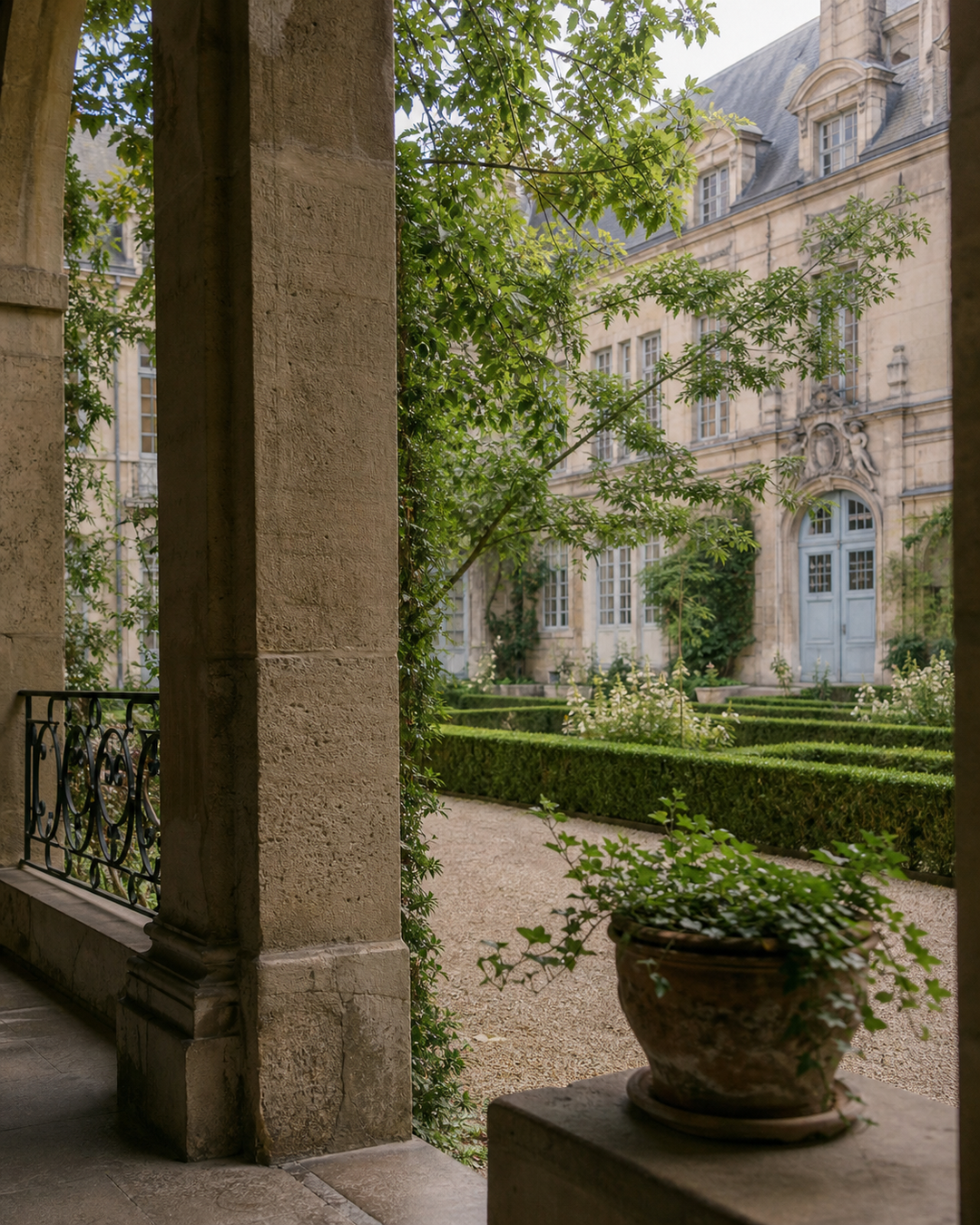
Move unhurriedly; give each threshold a few quiet minutes. Before you go, check each site’s official page for current access and any special notices.
1) Jardins des Archives Nationales (Marais)
Begin among clipped greens and stone façades. Follow the garden sequence as it unfolds: from the Hôtel de Rohan to the small hôtels along Rue des Francs‑Bourgeois, tracing the old property lines. Pause where gravel meets grass; notice carved lintels and the way light strikes the façades. If you find the Hôtel d’Assy garden, linger by the 1848 water feature and look for the mature Himalayan chestnut.
What to notice: changes in scale between courts, the hush along the Ruelle de la Roche, and how plantings buffer the city’s sound.
Practical: The gardens are open to the public; details and updates are on the Archives nationales site.
2) Musée Carnavalet — Histoire de Paris
Stroll a few minutes to the city’s museum of Parisian history. The museum is open Tuesday to Sunday, 10:00–18:00, and closed on Monday. Exhibition rooms close at 17:45. The permanent collections are free of charge and can be accessed without booking. Step inside for a compact wander through rooms that trace the city’s life across centuries, then return to the courtyard air.
What to notice: thresholds between galleries, signage fonts from different eras, and small architectural fragments that once lived on the street.
Practical: If you plan to see a temporary exhibition, consult the museum’s page; the ticket office closes at 17:15.
3) Hôtel de Sully → Place des Vosges
Continue to the Hôtel de Béthune‑Sully. Its courtyard and garden are in free access, and there’s a bookshop to browse. Cross the court slowly—stone underfoot, ironwork above—then slip through the passage that leads directly to Place des Vosges. Step out into the square and choose a quiet corner under the arcades to sit, sketch, or simply watch light passing across brick and limestone.
What to notice: the shift from intimate court to grand square; how arcades frame the sky.
Practical: Courtyard and garden access at the Hôtel de Sully are indicated as free; see the monument’s page for current information.
An alternative, if you crave arcades
If you’d like another “village in the city,” consider the Domaine national du Palais‑Royal near the Louvre. Its garden, recognized as a Jardin Remarquable, is ringed by arcades that invite an unhurried loop and a seat among plane trees. Check the site’s practical information for hours and any updates.
How to pace a half day
- Keep the route tight: Archives Nationales → Carnavalet → Hôtel de Sully → Place des Vosges. Everything is within easy walking distance.
- Give yourself margins: 20 minutes of garden quiet; 45–60 minutes inside Carnavalet’s free permanent collections; 10–15 minutes in the Sully court before drifting to the square.
- Bring a small notebook. Write one sensory line in each place before you move on.
- Wear soft‑soled shoes; many surfaces are stone or gravel.
At‑home practice: a morning “courtyard”
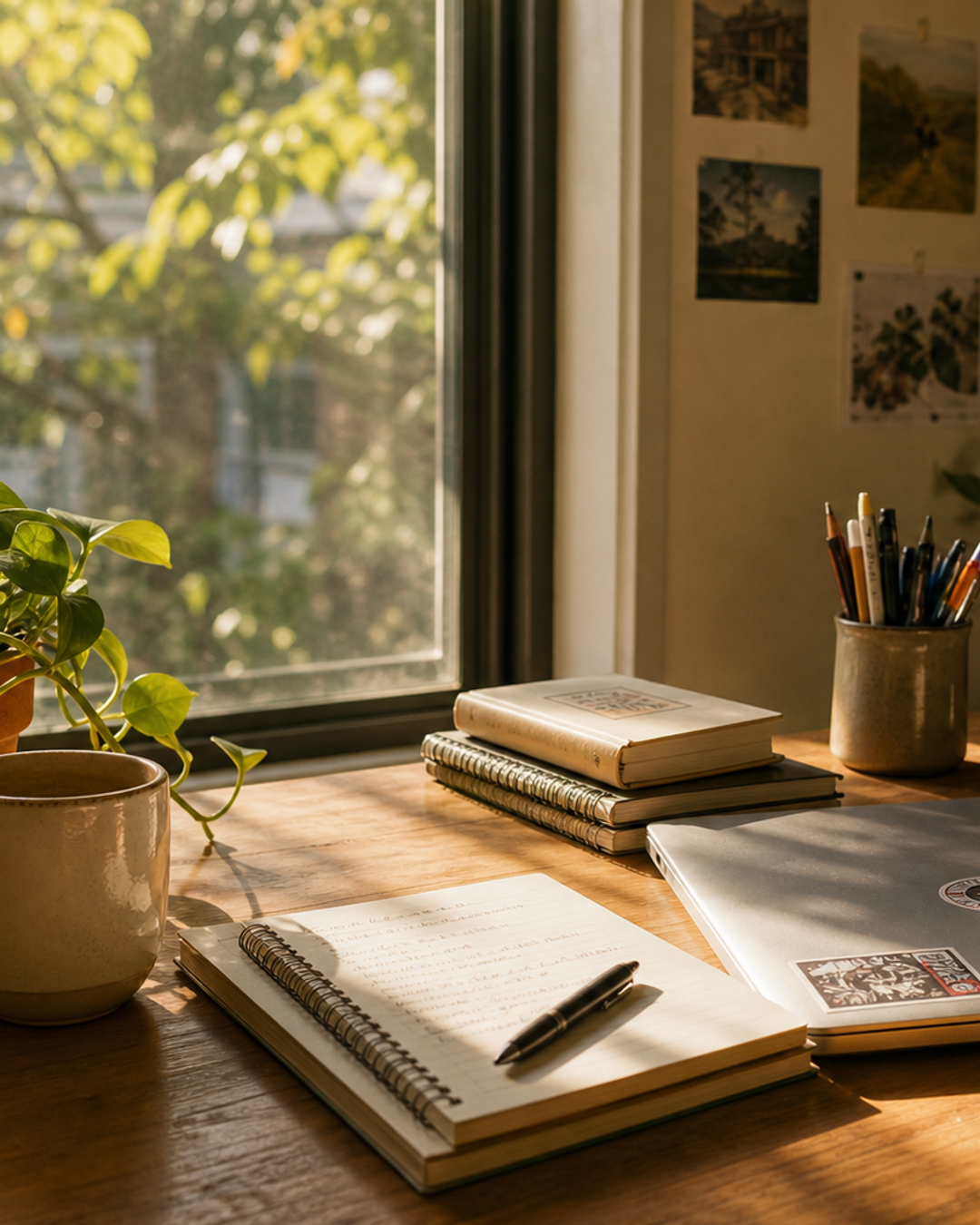
Tomorrow, build a pocket of stillness at home that echoes these interiors:
- Open a window.
- Brew strong coffee or tea; slice a crisp baguette.
- Light a thin candle and sit facing a plant or a photo of stone and iron.
- Keep the ritual to 20–30 minutes. Listen for street sounds, feel the temperature on your skin, and write one sensory line in a notebook.
Journal prompts
1) Describe a hidden place from your childhood that felt like a private world.
2) What small set of objects would make a perfect morning corner for you this autumn?
Practical reminders
- Check official pages on the morning of your visit for access and any special notices, especially museum schedules and temporary exhibition details.
- The Musée Carnavalet permanent collections are free and do not require booking; it is open 10:00–18:00 Tuesday to Sunday and closed Monday. Exhibition rooms close at 17:45.
- The Hôtel de Sully indicates free access to its courtyard and garden.
- The Jardins des Archives Nationales are open to the public; consult the site for current information.
Sources for this article
- https://www.archives-nationales.culture.gouv.fr/en/gardens-haven-greenery
- https://www.carnavalet.paris.fr/en
- https://www.hotel-de-sully.fr/en/
- https://www.domaine-palais-royal.fr/en/